

Here is the short answer before I get into the labels. For Honey, our ten-year-old yellow Labrador mix, I use Nordic Naturals Omega-3 Pet, and I have since mid-June, when our vet recommended it alongside Cosequin. Five months in, I would make the same choice again. Salmon oil is not a bad product, and there are dogs it suits better than it suits Honey. But if you are standing in an aisle trying to decide between them, the real differences are printed on the label, and they are easier to read than the bottles make them look.
I am not a veterinarian. I am a retired school librarian who spent thirty-two years around reference materials, so I do what librarians do. I read the fine print, I write things down in a notebook, and I check before I believe. What follows is what I found when I compared the label on the bottle in my refrigerator door with the labels on the salmon oils I looked at online, and with what a friend from church has told me about the one she has used on her golden retriever for two years.
| Nordic Naturals Omega-3 Pet | Salmon oil for dogs | |
|---|---|---|
| What it is | Liquid fish oil, 8 ounces, unflavored, stated as 1,380 mg of omega-3 fish oil including EPA and DHA | Liquid salmon oil, bottle sizes vary by brand |
| EPA and DHA on the label | Broken out on the bottle, alongside the total fish oil | Sometimes stated, sometimes not broken out at all |
| Molecular form | Triglyceride form, and the label says so | Usually not stated anywhere on the bottle |
| Ingredient list | States what is excluded: non-GMO, gluten- and dairy-free, no artificial colors, flavors or preservatives | Typically one ingredient, salmon oil, and nothing else to read |
| Smell and taste | Unflavored, mild fish smell | Stronger fish smell, which many dogs find appealing |
| Allergen note | States plainly that it contains fish | Also fish, though not every label says so out loud |
| Best for | Dogs who need a consistent, stated amount of EPA and DHA every day | Dogs who need a stronger smell to finish their dinner |
How I Ended Up With Two Labels to Compare
Honey started getting stiff after her naps in January. Not lame, not crying out, just slow. She would wake up on the quilt on the couch and take a few seconds to decide whether standing was worth the trouble. The three wooden steps from the back porch down to the yard started coming one at a time. By spring she was hesitating before jumping into the back seat of my car, and that is what finally made me pick up the phone.
Before that I had tried a soft chew from the pet store, because it was the first thing on the shelf and I did not know any better. Four months of it gave us a small change at best, which is what sent us to our vet in early June. She went over Honey's hips and her left elbow carefully and told me what I had already suspected. Early arthritis in both hips, mild in the left elbow. No surgery. No prescription pain medication. She suggested Cosequin and a fish oil, and she said the fish oil part almost in passing, the way she might remind me to keep walking her.
I ordered the Nordic Naturals bottle that same week. The salmon oil came into the conversation later, from a friend at church who has used it on her golden retriever for two years and thinks I am overcomplicating the whole business. She may be right. But when I sat down with both labels and my reading glasses, the differences were not the ones I expected.
What the Nordic Naturals Label Says, Line by Line
The bottle in my refrigerator door holds eight ounces, which is 237 milliliters. The label calls it unflavored liquid fish oil and states 1,380 mg of omega-3 fish oil with EPA and DHA. It also lists benefits for coat, eyes, heart and immune support, which is the kind of language nearly every supplement on that shelf uses. What I cared about was further down the label.
Three things there mattered to me. First, it says the oil is in the triglyceride molecular form, the form naturally found in fish. I had to look that up, and I asked our vet to confirm it before I put any weight on it. Second, it states that nothing artificial is in the bottle: no artificial colors, flavors or preservatives, and that it is non-GMO and gluten- and dairy-free. Third, and this is the librarian in me, it actually breaks out the EPA and DHA instead of saying fish oil and leaving me to guess at the rest.
It also says plainly that it contains fish. If your dog has a fish allergy, that one line matters more than everything else printed on the bottle.
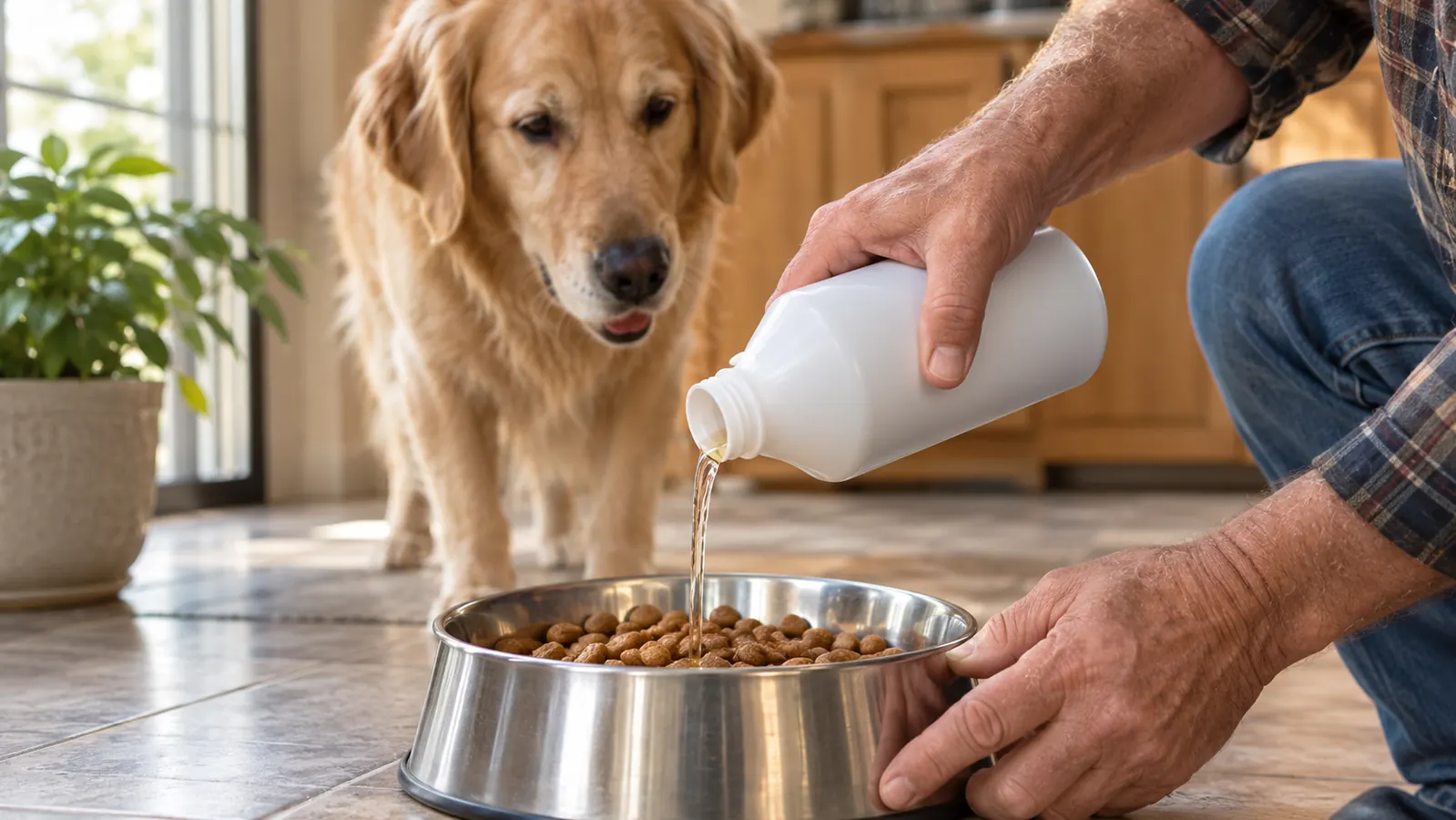
Storage is on the label too. I keep the bottle in the refrigerator door and measure it over Honey's dinner kibble each evening, per the label for her weight, and our vet agreed with that amount. She eats it without any fuss, which surprised me, because unflavored does not mean no smell.
What a Salmon Oil Label Usually Says
Salmon oil is simpler, and I mean that as a compliment as much as anything else. Most bottles are one ingredient: salmon oil. No long list to decode, nothing to look up, nothing to spell out loud at the counter. For a lot of people that is exactly what they want from a supplement, and I understand the appeal.
What varies is what the label does not tell you. Some salmon oils state their EPA and DHA and some do not break those numbers out at all. Some name the species and the water it came from, and some say only salmon. Whether the oil is in triglyceride form is usually not mentioned. I sat down one evening with four or five labels on my screen and my reading glasses on, and I could not answer those questions for most of them. That does not make the products bad. It means the label is quiet.
The other thing salmon oil has going for it is that dogs tend to like it. The smell is stronger and fishier than the mild oil in my refrigerator. My friend says her golden retriever hears the bottle come out and comes running, which is more than I can say for any tablet in this house. Honey is not a picky dog, so I can only report that secondhand.
The label on the bottle in my refrigerator door states 1,380 mg of fish oil with EPA and DHA, in the triglyceride form, with no artificial colors, flavors or preservatives. I could not find that same sentence on any salmon oil I looked at.
What I Watched For Over Five Months
I kept a notebook, because that is what I do. Every few weeks I wrote down four things: how Honey got up from a nap, how she did on the porch steps, whether she hesitated at the car, and how her coat looked. I did not change anything else in her day. Same two walks, morning and late afternoon, about twenty minutes each. Same food in the same bowl. The only additions in June were the Cosequin and the Nordic Naturals bottle, both started the same week on our vet's advice.
That is the honest limitation of my comparison. Because both started together, I cannot separate what the fish oil is doing from what the Cosequin is doing. What I can tell you is what I noticed. Around six weeks in, late July, the first steps after a nap got easier and the porch steps got smoother. Her coat looks softer to me, though I am her mama and not a judge. I am not going to sit here and tell you a bottle of fish oil fixed my dog. I am telling you it is part of a routine that is working better than the routine she had in January.

Where Nordic Naturals Wins
The case for Nordic Naturals, at least in my kitchen, comes down to three things. A stated amount of EPA and DHA. A stated molecular form. And a clear statement of what is not in the bottle. When you are giving something to a dog every single evening for months on end, that consistency matters more than any claim on the front of the label. I know what Honey is getting because the bottle tells me, and I do not have to take anyone's word for it.
The second thing is that it is a liquid I can measure onto her kibble in about four seconds. No pill pocket, no hiding a tablet in a spoon of chicken, no negotiation with a ten-year-old dog who has opinions about her dinner. Breakfast is already the Cosequin tablet, so having the evening be that easy counts for something in a house where I am the only one doing the lifting. The bottle is also small enough to live in the refrigerator door without taking over a shelf, which matters in a kitchen as small as mine.
Where Salmon Oil Wins
Here is where I hand it to salmon oil. If your dog turns her nose up at a mild oil, the stronger smell is often the difference between a dog who cleans her bowl and a dog who walks away from it. That is not a small thing. A supplement a dog will not eat is a supplement you have wasted, no matter how good the label looks to a retired librarian with a notebook.
Salmon oil is also easier to understand at a glance. One ingredient, one bottle, fewer decisions. If you like keeping things as close to whole food as you can, that simplicity has real appeal, and it is honest appeal. My friend at church has used it for two years and her dog is doing well on it. I am not going to argue with her dog.
If you want the EPA and DHA stated on the bottle, this is the one in my refrigerator door
Nordic Naturals Omega-3 Pet, unflavored liquid fish oil, 8 ounces, stated as 1,380 mg of fish oil with EPA and DHA. I measure it over Honey's dinner kibble, per the label for her weight, with our vet's agreement.
Amazon Check Today's Price on Amazon →Who Should Buy Which
Nordic Naturals is the better fit if you want to know exactly how much EPA and DHA your dog is getting, if your dog is already on a joint supplement and you want the extras kept simple, or if your dog will eat a mild oil over kibble without a fight. It is also the one I would point you toward if your dog is like Honey: older, a little stiff after naps, eating well, and not interested in performing tricks for a tablet.
Salmon oil is the better fit if your dog is a fussy eater who needs a stronger smell to get interested, or if you simply want one ingredient and no other decisions to make at the counter. Either way, talk to your vet before you start. Fish oil is not nothing. It can interact with medication, and the amount that suits a seventy-pound dog is not the amount that suits a twelve-pound one. Follow the label and ask.
Honey is better, not cured. She still takes the porch steps one at a time on cold mornings, and she still sometimes waits for a hand under her hips to get into the back seat of the car. I cannot tell you which part of her routine is doing the work, and I would be fibbing if I pretended I could. What I can tell you is that the label on the bottle in my refrigerator door tells me exactly what I am giving her, and after thirty-two years of checking references, that is the part I trust.
Read the label yourself, then decide
Eight ounces of unflavored liquid fish oil, 1,380 mg with EPA and DHA, triglyceride form, no artificial colors, flavors or preservatives. Start with your vet and the label for your dog's weight.
Amazon Check Today's Price on Amazon →