

Honey started getting stiff after her naps in January. Not dramatic, not a yelp or a limp, just a slow unfold when she stood up from the quilt on the couch, and then a pause at the top of the three back porch steps like she was doing arithmetic in her head. She was nine then. She is ten now, a yellow Labrador retriever mix, about seventy pounds, and she has been mine since I adopted her from the county shelter eight years ago.
I did what I always do when something worries me. I got a notebook and started writing things down. And in early February, before I had even picked up the phone to call our vet, I bought a bag of VETIQ Glucosamine Hip & Joint Chews for Dogs at the grocery-store kind of price that made the decision easy. This is my honest account of the four months Honey took them, what I saw, what I did not see, and who I think they are actually right for.
The Quick Verdict
A fair, affordable soft chew with a readable label and a chicken flavor dogs actually eat. It is a reasonable first step for a mildly stiff older dog, but it is not a substitute for a diagnosis, and four months on it did not do for Honey what our vet eventually did.
Amazon Check Today's Price →The chew that got Honey through her first four stiff months
180 soft chews, chicken flavor, one a day for a seventy-pound dog per the label. If your dog is just starting to show a little morning stiffness, this is an inexpensive place to begin while you get a vet appointment on the calendar.
Amazon Check Today's Price on Amazon →How I've Used It
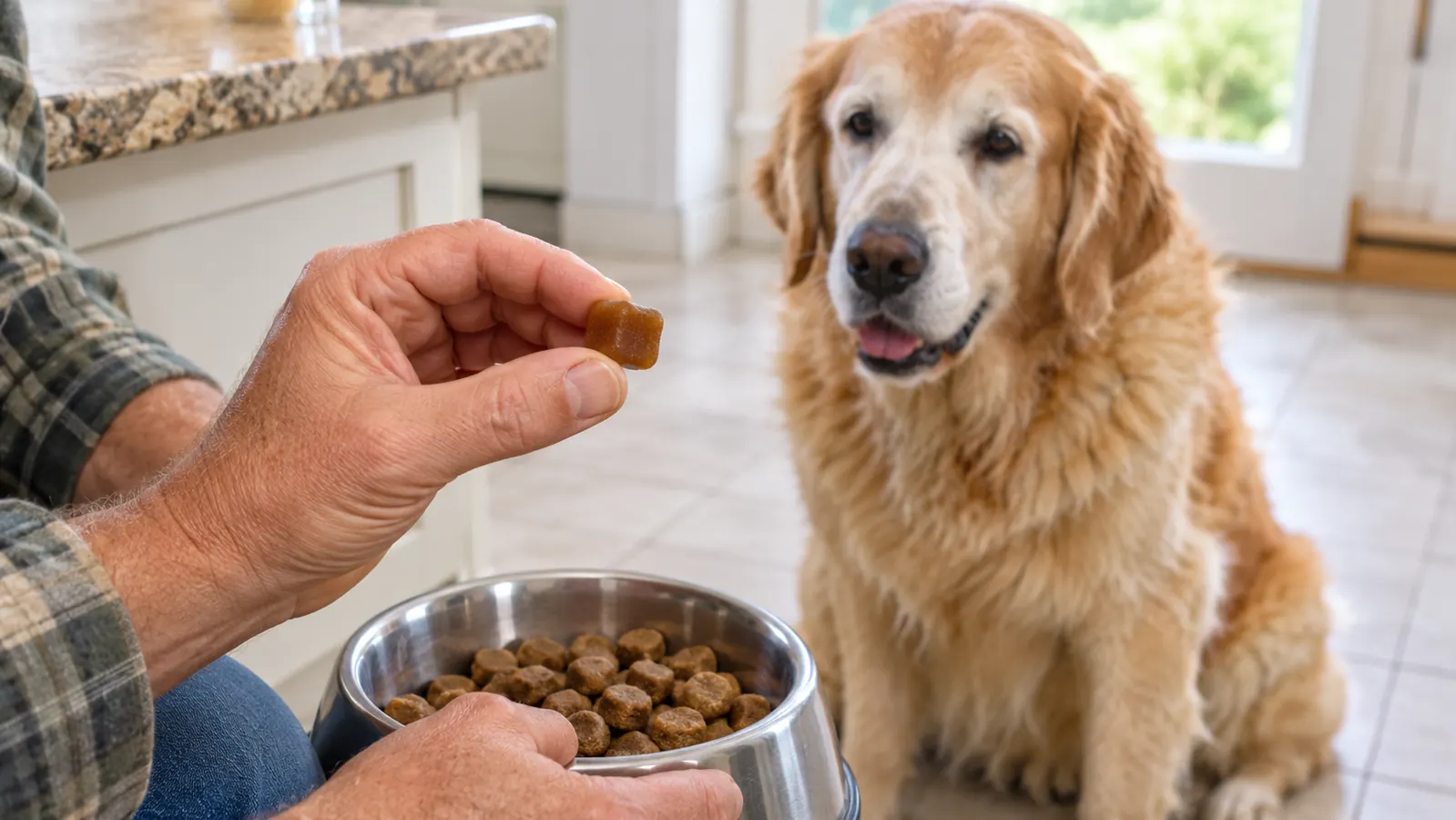
Honey took VETIQ from early February to the first week of June. One soft chew with breakfast, per the label for her weight, and our vet agreed with that when I finally got her in. She ate it like it was a treat, which mattered more than I expected. I have since learned that a supplement a dog refuses is a supplement you have wasted money on.
Feeding it was the easy part. The bag came on a Thursday and I opened it at the kitchen counter with my glasses on and the notebook already out. The chews are soft enough that pressing one with my thumbnail left a dent, and they smell faintly of chicken and fish, which Honey found extremely interesting. I put the first one on top of her kibble rather than in my palm, because Honey has a habit of taking something from my hand, carrying it three feet, and setting it down on the tile with a look of quiet betrayal. In the bowl she never noticed it at all. From then on it went in the bowl and that was the end of the discussion. A hundred and twenty mornings, give or take, each one with a check mark beside it in the notebook.
I kept the bag on the shelf in the kitchen cabinet next to the refrigerator, and I kept the notebook on the counter. Every morning I wrote the date and one word about how she came off the couch, and whether she took the porch steps one at a time or two in a row. It is not a scientific record. It is a librarian's record, which means it is at least consistent.
In June, our vet looked at her, moved her hips through their range, watched her walk, and told me Honey had early arthritis in both hips, mild in the left elbow. She started her on a different joint product and a fish oil. I stopped the VETIQ that same week so Honey would not be taking two glucosamine products at once. I want to be plain about that: I did not stop because anything went wrong. I stopped because the vet wanted a clean starting point, and doubling up on an ingredient is not something I was going to do on my own.
What the Label Actually Says
Here is where I put my glasses on and read carefully, because a great many dog chews are mostly chicken meal and good intentions. The VETIQ label lists glucosamine HCL at 600 mg per chew, fish oil at 280 mg, and krill at 210 mg, along with MSM. That is a real amount of the thing people buy these chews for. The bag is 180 soft chews and comes in chicken flavor, and the whole thing weighs about a pound and a half, which tells you roughly how big each chew is.
I bought the bag at the feed store on a Saturday and stood in that aisle a good ten minutes doing what I always do, which is turn the package over and read the back panel twice. There was another bag on the shelf beside it with a picture of a dog running through a meadow, and I could not find the glucosamine amount anywhere on the front of it. That decided me more than any claim on either package. I am not a chemist and I am not a nutritionist, but I spent thirty-two years teaching children how to find the information they need, and a package that hides the numbers is telling you something.
The listing also mentions support for digestive health and skin and coat health alongside joint health, which is the sort of thing I read with one eyebrow up. A supplement that claims to do everything is often doing one thing passably. I bought it for hips. I judged it on hips.
What I appreciated was that I could find the numbers without a magnifying glass, and that the ingredient names were ones I could look up and understand. At this price point, that is not nothing. I have stood in a pet store aisle holding a bag where I could not find the glucosamine amount anywhere on the front of the package, and I put it back on the shelf.
Four Months, One Notebook
The honest answer is that I saw a small change at best. Around week five or six there were a few mornings where Honey came off the couch without that long pause, and I wrote it down and felt pleased. Then the next week she was slow again, and the week after that she hesitated at the car door, which she had not done before. I could not draw a straight line through my own notes.
I can tell you exactly what the notebook says, because I still have it. February 9: came off the couch slow, one step at a time on the porch. February 22: same. March 8: up quicker, took the porch steps two and two. March 15: slow again. April 4: hesitated at the car door, first time I had written that down. April 19: fine in the morning, stiff after her afternoon nap. There is no pattern in those lines that a reasonable person could point to and call improvement. What there is, if I am honest, is a dog who was a little better some days and a little worse others, which is what an older dog does anyway, supplement or no supplement.
That is what sent me to the vet. Not a crisis. A flat line. Four months is a fair trial for a supplement and my notebook did not show a trend worth bragging about.
I want to be careful here, because I am not a veterinarian and I never will be. It is possible that VETIQ was doing something quiet that I could not measure from a kitchen counter. It is also possible that Honey needed a higher amount than the label gave her for her weight, and that a vet would have told me that in February if I had asked. That is the actual lesson of this review: I should have called the vet first and shopped second, not the other way around.
Four months is a fair trial for a supplement, and my notebook did not show a trend worth bragging about.
How It Compares to What Our Vet Chose
I am not going to pretend these two products are the same thing at different prices, because they are not. The chew our vet started in June is a different formulation and a different chewable, and our vet set the starting amount for Honey's weight rather than leaving it to the bag. Within about six weeks of that switch, I had the first change I could honestly point to: fewer stiff first steps after a nap, and smoother work on the porch steps. On cold mornings she still takes them one at a time, so I am not going to tell you it was a cure for anything.
What I will say for VETIQ is that it is a fair budget pick for someone starting out. If you have a dog who is only just beginning to show a little stiffness and you have not yet been to the vet, an inexpensive soft chew with a clear label and a chicken flavor your dog will actually eat is not a foolish first move. It is a holding pattern. It is what you do while you wait for an appointment, not what you do instead of making one.
I have written out a fuller side-by-side of the two if you want the details, and I have also set down the reasons these chews fit so easily into a daily routine, and why I picked them in the first place that February. But the short version is this: VETIQ was the right shape of product for where we were and the wrong strength of product for where Honey actually was, and I could not have known that without a vet's hands on her hips.

The Everyday Practicalities Nobody Mentions
A few small things that matter more than the marketing copy suggests. The chews are soft, so I could break one in half if I ever needed to, though at Honey's weight the label called for a whole one and I gave a whole one. They do not crumble into dust at the bottom of the bag the way some do, and the bag reseals well enough that they stayed soft for the full four months.
The bag itself is listed at nine by seven by three inches, and it stands up on its own on the cabinet shelf next to the refrigerator without slumping over onto the canned goods. That sounds like a small thing until you have had a bag of something slump over onto the canned goods every single morning for a month. The zip top has held through four months of opening and closing, and I never once had to move the chews into a container. I have done that transfer with other things and then lost track of what was in the container and when I bought it, so I count the bag as a small mercy.
Honey has a sensitive stomach in the sense that she will eat grass and then look at me like I arranged it. She had no digestive trouble on these at all, which I consider a point in their favor. Some supplements go straight through her. These did not.
The one caution I would pass along is the shellfish note on the label. The glucosamine is shellfish-derived. If your dog has ever had a reaction to shellfish or you are unsure, that is a question for your vet and not for a review written by a retired librarian. I asked, and I would ask again.
What I Liked
- Clear numbers on the label: 600 mg glucosamine HCL, 280 mg fish oil, 210 mg krill, plus MSM
- Chicken flavor that Honey took as a treat without any coaxing
- Soft chew breaks easily and stayed soft in the resealed bag for four months
- Gentle on a dog with a touchy stomach, no digestive upset in sixteen weeks
- A very low-cost way to start supporting an older dog while a vet visit gets scheduled
- 180 count means a dog Honey's size gets about six months out of one bag
Where It Falls Short
- Four months produced no change I could honestly call clear on a stiff older Labrador
- The label amount is fixed, so there is no adjusting for weight without a vet's input
- The listing mentions digestive and skin and coat benefits, which muddies what it is really for
- Glucosamine is shellfish-derived, which rules it out for some dogs
- It is not a diagnosis and not a replacement for one, and I treated it that way too late
Who This Is For
I would hand this bag to someone whose dog is in the first stage of what I saw in January. A dog who is a little slow getting up after a long nap. A dog who pauses a beat before the porch steps but still takes them. A dog who is nine or ten and otherwise healthy and happy, and whose owner has not yet sat in a vet's exam room with a question about arthritis. That owner should buy these and also make the phone call, in whichever order gets both done this week.
It also fits a household on a fixed income, and I say that as a woman on one. There is a real difference between a supplement you can sustain and one you admire on a shelf. VETIQ is sustain-able, and a modest chew given faithfully beats a fancy one given for two weeks and then abandoned.
Who Should Skip It
If your dog has already been diagnosed, if a vet has already named arthritis and talked about cartilage and hips and elbows, then this is probably not your product. Honey was past it by June. A dog who cannot get up without help, who is limping consistently, who has stopped wanting the walk at all, needs an appointment and a plan, not a bag of soft chews from the grocery aisle.
Skip it too if your dog has a shellfish allergy, if your vet has put your dog on a prescription joint diet or a prescription medication that could overlap, or if your dog is a picky eater who turns her nose up at chicken-flavored anything. Honey is not that dog, but I have met her cousins.
And skip the idea, if you are carrying it, that any chew on a shelf is going to fix a hip. It will not. It might help a little, for a while, for a dog whose problem is still small. That is the whole honest scope of it.
If your dog is at the pause-before-the-steps stage, start here while you wait for the vet
Chicken-flavored soft chews, 180 count, with the glucosamine and MSM amounts printed where you can read them. What Honey took for four months before our vet gave us a real plan.
Amazon See Current Price and Details on Amazon →