

Most people do not come to this question on purpose. They come to it in the supplement aisle, holding a tub of soft chews in one hand and a bag of green-lipped mussel powder in the other, trying to work out which one their dog will still be taking in six months. I have stood in that aisle with my reading glasses pushed up on my head and a list in my pocket. I am not a vet. I am a retired school librarian with a ten-year-old Labrador mix and a notebook, and I read labels for a living once and never stopped.
The short answer, if you want it before the reasoning: if your dog takes a treat without a fight and you want one fixed serving you never have to think about, the Zesty Paws Mussel Mobility Bites are the easier choice. If your dog is on a plain diet, or you want to control the amount down to the quarter scoop, plain green-lipped mussel powder is the better fit. I use the bites. I have not used the powder. More on that in a moment.
| Zesty Paws Mussel Mobility Bites | Plain green-lipped mussel powder | |
|---|---|---|
| Form | Soft chew, chicken and mussel flavor, 90 chews in the tub | Loose powder, measured with a scoop |
| What is in it | Green-lipped mussel plus natural glucosamine, chondroitin and omega-3 fatty acids | Green-lipped mussel, with very little else on the label |
| Giving it | Hand it over as a treat after the walk | Measure and mix into the food |
| Picky dogs | Flavored chew, eaten like a biscuit | Can be smelled in the bowl and refused |
| Control over the amount | One chew per the label for the dog's weight | You set the amount, down to the quarter scoop |
| Extra ingredients | Lists chamomile and a flavoring | One ingredient, nothing added |
| Cost per serving | Higher per serving | Lower per serving, bought in bulk |
| Storage | Tub on a dry shelf, 90 chews | Must be sealed tight, clumps near steam |
| Best for | Dogs that take treats, owners who want a fixed serving | Dogs on a plain diet, owners who want to adjust the amount |
Here is how I came to any of it. Honey is my ten-year-old yellow Labrador retriever mix, about seventy pounds, and I adopted her from a county shelter when she was two. In January I noticed she was stiff after her naps. By June our vet had looked at her and said early arthritis in both hips, mild in the left elbow. No surgery, no prescription pain medicine, just a dog who had started taking the three back porch steps one at a time.
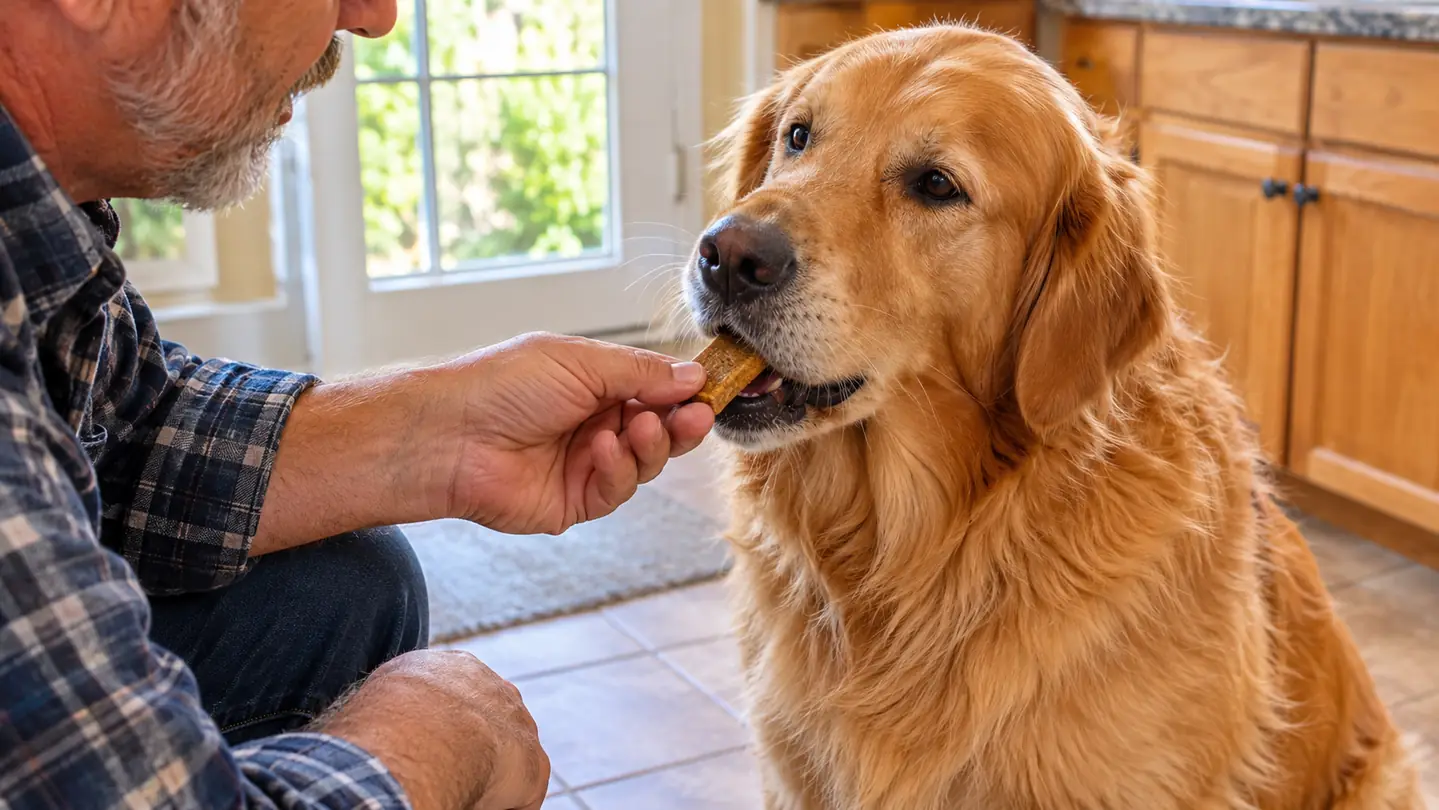
Since early August she has had one Zesty Paws Mussel Mobility Bite as her treat after the afternoon walk, and our vet said that was fine to add to what she was already taking. That is the whole of my experience with it: one chew a day, handed over the way I used to hand over an ordinary biscuit. I never bought plain mussel powder. What I know about it comes from reading the tubs at the feed store and from a friend at church who used it on her own dog for the better part of a year.
Before any of this I tried the inexpensive thing first. In early February, weeks before I had made the vet appointment, I bought a tub of VetIQ Glucosamine Hip and Joint Chews because they cost the least of the ones on the shelf and they were chicken flavored, and I thought, well, it cannot hurt. Honey ate them happily for four months, one with breakfast per the label for her weight, and I saw a small change at best. That is what sent me to the vet in June, and that is where the Cosequin and the fish oil came from. I stopped the VetIQ that same week so she was not doubling up on glucosamine. I still think it is a fair budget pick for someone just starting out. It simply was not enough for her.
Where Zesty Paws Mussel Bites Wins
The first thing the bites have going for them is that they are a treat. Not a supplement disguised as a treat, actually a treat, in a chicken and mussel flavor, and Honey takes it from my fingers the same way she took a biscuit for eight years. That sounds small. It is not small. A supplement only works if it gets into the dog, and the most common reason a supplement stops is that the dog stops eating it.
The first one I gave her was on a Tuesday afternoon in early August, on the back porch, right after we came up those three steps. She took it and then looked at me for another, which is exactly what she does with a biscuit, and that settled the question of whether she would eat it. A tub of ninety at one a day is about three months, so mine is nearly done now, and the reorder is already written on the list that hangs by the door.
The second is that the serving is fixed. One chew, per the label for her weight, and our vet agreed with the label. I do not measure. I do not scoop. I do not wonder whether the powder clumped at the bottom of the bowl. When I open the cabinet next to the refrigerator and take out the tub, the amount is already decided. For a household with one dog, one person and a pill organizer on the counter, that matters more than it probably should.
The third is what else is in the chew. The listing says the mussels are cold processed from New Zealand and that the bites also carry natural glucosamine and chondroitin plus omega-3 fatty acids, which is more than mussel on its own. If you are already giving a joint supplement and a fish oil, as I am, tell your vet what is in the tub so nothing gets doubled up. I did, and that is why our vet approved adding it rather than replacing anything.
I want to be careful here, because I have not seen a dramatic change I could pin on the bites. Honey's better days started before August, and she is on three other things besides. What I can tell you is that she has not refused one, not once, and that the tub has lasted the way it should. Consistency is the only part of this I can actually vouch for, and I would rather say that plainly than dress it up.
Where Plain Mussel Powder Wins
Now the other side, and I want to be fair to it, because there are dogs for whom the powder is plainly the better answer. A plain powder is one thing. The tubs I read at the feed store listed green-lipped mussel and very little else, no flavoring, no binder, nothing to set off a dog with a touchy stomach or a long list of things she cannot have. If your dog reacts to everything, fewer ingredients is not a compromise. It is the whole point.
The powder also gives you control I do not have. You set the amount, you can start with less than the label suggests and build up, and you can split it across two meals if your dog eats better that way. With a chew, the amount is the chew. I like that. A friend of mine with a smaller dog, and a dog who is fussy about anything new, would not, and she would be right not to.
I asked that friend twice before I wrote any of this, because I would rather report what someone actually did than what I assume. She used a plain mussel powder on her own dog for close to a year and told me the dog never noticed it stirred into a wet meal, and that when she tried it over dry kibble the dog walked away from the bowl. She also began at half the scoop for the first two weeks, which is not a thing you can do with a chew. I have not read the back of the tub she used, so weigh that as one woman's account and not a study.
And the powder is gentler on the budget per serving, because you are buying ground mussel in bulk rather than a chew with flavoring and a shelf life built in. That is a real consideration when you are buying something every month for a dog who may be on it for years. I will not pretend otherwise. The trade is that you have to measure it, you have to get it into the dog, and some dogs can smell it coming.
There is one more practical thing. Powder is powder. It clumps if the tub sits near steam, it dusts the counter, and it has a smell that is exactly what you would expect ground mussel to smell like. I keep the fish oil in the refrigerator door and the chews and tablets on one shelf, and I would not want a third thing in that cabinet that I had to scoop and seal and wipe up after.
The treat Honey gets after her walk now has a job
Zesty Paws Mussel Mobility Bites are soft chews with cold processed New Zealand green-lipped mussel, plus natural glucosamine, chondroitin and omega-3 fatty acids. One chew per the label for your dog's weight, and ask your vet before adding anything new to the routine.
Amazon Check Today's Price on Amazon →
The Label, Read Slowly
This is the part my family teases me about, so bear with me. The Zesty Paws tub I have holds 90 soft chews and weighs 7.9 ounces, and the tub itself is about 3.66 by 3.58 by 3.23 inches, small enough to sit on one shelf of the kitchen cabinet beside the refrigerator without reorganizing anything. The label lists it for hip and joint support, and it lists the benefits as antioxidant, joint health, muscle health and nutritional support.
I keep a notebook, the way I did at the library for thirty-two years, and the page for Honey has dates down the left margin and one line per change. August 4, first bite. August 18, nothing I could put a name to. September 2, came up the porch steps without stopping, though it was a warm morning and warm mornings have always been better for her. Whether the bites did that I cannot say, with three other things in the routine, but the notebook does not care about my theories. It only records what happened, in ink, which is the whole reason I keep it.
The active ingredients line on the listing says chamomile, which surprised me the first time I read it closely, and the listing describes the chews as limited ingredient. I am not a chemist and I am not going to pretend to interpret that for you. What I will say is that if your dog is on a prescription or another supplement, carry the tub to your vet and let her read the back. That is fifteen minutes of your life and it is worth all fifteen.
The powder labels are shorter, which is their appeal. But a short label does not tell you how the mussel was processed, and processing is the part that comes up in every conversation about green-lipped mussel. The bites say cold processed right on the front. If you go the powder route, look for that same phrase, and if it is not there, ask the company before you buy.
What I changed was not the supplement. It was the biscuit. The thing I was handing her anyway now has a reason behind it, and I did not have to talk her into it once.
Who Should Buy Which
Buy the Zesty Paws Mussel Mobility Bites if your dog takes treats easily, if you want one serving decided for you, and if you are comfortable with a supplement that has more in it than mussel alone. They suit a dog like Honey: seventy pounds, ten years old, on a routine that already includes a joint supplement and a fish oil, where the chew is replacing a biscuit rather than adding a new step.
Buy plain mussel powder if your dog is sensitive to flavorings or added ingredients, if you need to control the amount precisely, or if cost per serving is going to matter over a year of daily use. It is also the better choice if you already mix a powder into every meal and one more scoop is no work at all.
And buy neither, at least not yet, if your dog has not been seen. Stiffness after rest is not a diagnosis. Honey's turned out to be arthritis in both hips, but that took a vet, an exam and a conversation. A supplement is not a substitute for that appointment, and no chew on any shelf is going to tell you what is actually wrong.
If we were sitting at my kitchen table, here is what I would say. Start with the appointment, then with the label, then with the smallest version of whatever you choose. Do not add two new things in the same week or you will not know which one did anything. Write the start date on the tub with a marker, the way I do, and give it six weeks before you decide.
One tub, 90 chews, one less thing to measure
If a chewy treat fits your dog's routine better than a scoop, start with the label, then ask your vet. Honey has had hers since August and still takes it at the door.
Amazon Check Today's Price on Amazon →