

Last June our vet looked at Honey's X-rays, said the word arthritis out loud, and then wrote two things on a slip of paper: a glucosamine chew and a fish oil. I had already spent four months guessing with a budget chew I bought because the price was easy, so this time I did what I used to do when a library patron asked for a book I had not read. I went and read the label. The fish oil I brought home was Nordic Naturals Omega-3 Pet, the unflavored liquid in the eight ounce bottle, and it has gone onto her dinner every night since.
I am not a veterinarian and I am not going to write like one. I am sixty-seven, retired after thirty-two years in an elementary school library, and I live alone in Franklin, Tennessee with a ten-year-old yellow Labrador retriever mix named Honey. She is about seventy pounds, adopted from the county shelter when she was two, and she has early arthritis in both hips, mild in the left elbow. I bought the Nordic Naturals bottle myself on Amazon. So this is not really a review of a bottle. It is a description of a habit, because adding fish oil to a dog's meals is not complicated. It is only easy to get wrong.
The Bottle That Has Lived in My Refrigerator Door Since June
Nordic Naturals Omega-3 Pet, unflavored liquid, eight ounces, 1380 mg of fish oil with EPA and DHA. The listing shows a 4.5 rating across more than 12,000 reviews. Mine goes onto Honey's dinner, measured per the label for her weight and confirmed with our vet.
Amazon Check Today's Price on Amazon →Step 1: Ask Your Vet Before You Add Anything, Even the Gentle-Sounding Things
Fish oil has a reputation as the safest thing in the cabinet, and that reputation does a lot of quiet harm. It is fat, so it is calories. It can loosen a dog's stools in the first days, which is not an emergency but is not a good week either. And the allergen line on this particular label says Fish in plain letters, which is worth thirty seconds of your attention if your dog has ever had a reaction to seafood or to a fish-based food.
I carried the bottle into the exam room rather than describing it over the phone, and I am glad I did. Our vet turned it over, read the back, did the arithmetic for a seventy pound dog, and said we could start. Then she asked what else Honey was taking, and that question is the one that mattered. Honey had been on a glucosamine chew since February, and I had already stopped it when the Cosequin began so she was not getting the same ingredient from two directions at once. If I had quietly added a third thing without saying so out loud, nobody in that room would have known.
Four minutes of conversation. That was the whole of it. Whatever your own vet charges for a phone call or a technician appointment, it is less than the cost of finding out the hard way in three weeks.
Step 2: Read the Label Before You Read the Reviews
The front of this bottle states 1380 mg of fish oil with EPA and DHA. The back tells you it is in the triglyceride molecular form, which the listing explains is the form naturally found in fish, and that it is non-GMO, gluten free and dairy free, with no artificial colors, flavors or preservatives. It is a liquid, and the flavor is listed as unflavored. I wrote all of that in my notebook the day it arrived, not because I follow the chemistry, but because a label is a set of claims and I like to know which claims I am actually paying for.
Here is the part I want you to notice, because it is the part that made me decide to be straight with you. The benefits printed on this bottle are coat, eyes and heart. Joints are not on that list. Our vet recommended a fish oil anyway, because EPA and DHA are the part of it that interests her for an older dog, and there is reasonable thinking behind that. But I am not going to hand you a bottle and tell you the label promises new hips. It doesn't. What it promises is what it says, and the rest is a conversation between you, your dog and your vet.
One more thing about reviews, since I read plenty of them myself. The listing shows a 4.5 rating across more than twelve thousand of them. That tells you a great many dogs tolerate this and a great many people find it easy to use. It does not tell you what it will do for your dog. Twelve thousand strangers is not evidence about one seventy pound Labrador in Tennessee.
Six weeks in, the change I could actually point to was a softer coat. I cannot tell you the fish oil did that and the Cosequin did not, and I have stopped pretending I can.
Step 3: Measure What the Label Says for Her Weight, Not What a Stranger on a Forum Says
The directions on the bottle go by weight, which means the right amount for Honey is not the right amount for a beagle or a Great Dane. Our vet confirmed the label amount for a dog her size, and that is what she has had since mid-June: one measured amount over one meal, every day, with no doubling up on a bad morning because I feel sorry for her.
I am deliberately not typing a number here. Not because I am being coy, but because you and I have different dogs, and a number copied off a stranger's article is how a nine pound terrier ends up with the amount meant for a retriever. Read the label. Ask your vet to confirm it for your dog. Then write the amount on a sticky note and put it on the inside of the cabinet door where you keep the bottle, so six weeks from now you are not squinting at the fine print with your reading glasses pushed up on your head.
The other half of measuring is not skipping. Fish oil is not a pain pill. There is no hour later when you can tell it wore off, and that makes it very easy to let a Tuesday slide into a Thursday. The mornings I notice Honey stiffest are the ones after a cold night, not the ones after a missed spoonful, which is exactly why the notebook in step five earns its keep.

Step 4: Put It on the Food She Already Finishes
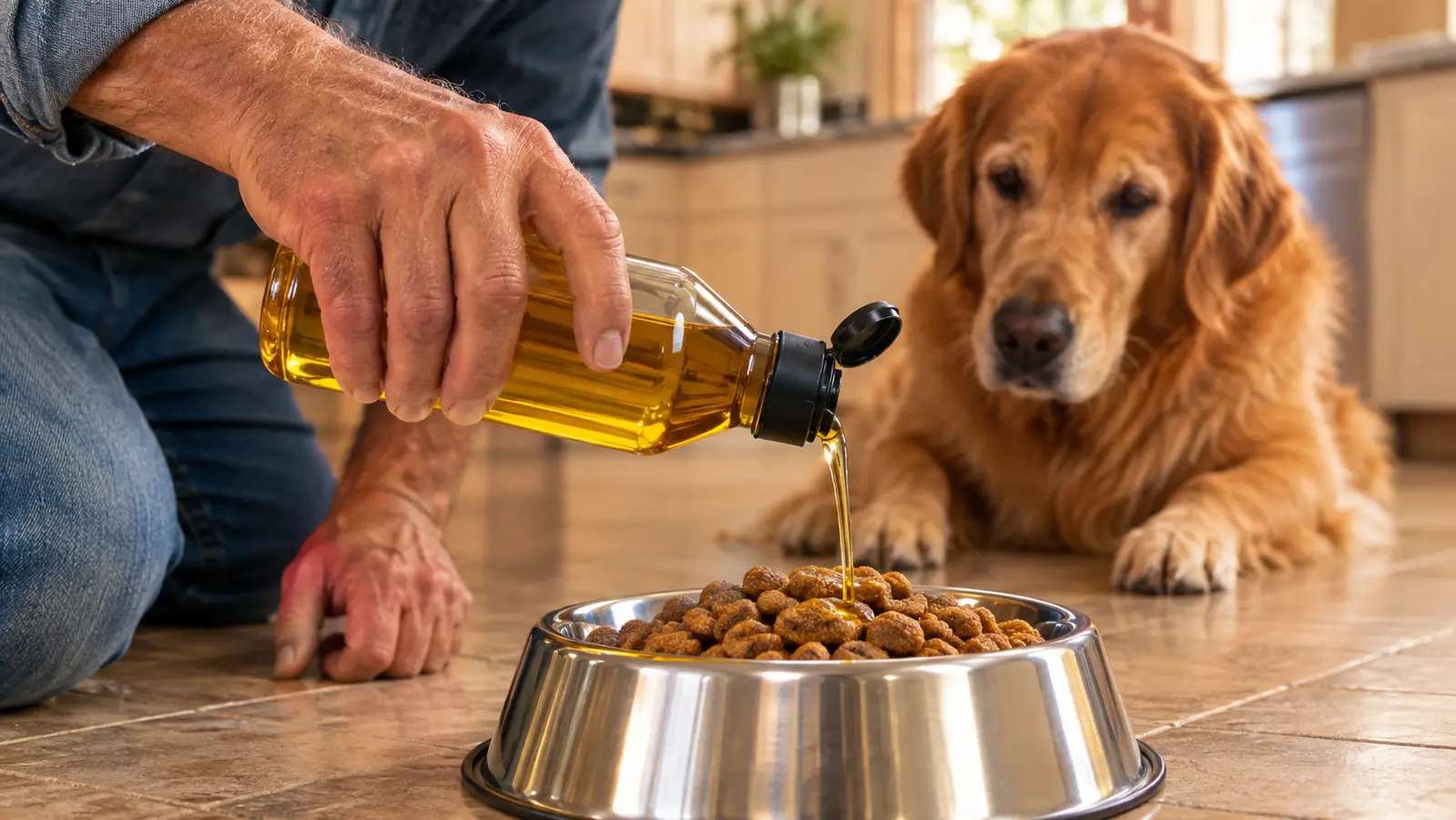
The first week I made a small production of it. I stirred it into a little dish of kibble and set it down like a lady serving a sauce. Honey looked at it, looked at me, and walked to her regular bowl. Now I pour it straight over her dinner kibble in the bowl she has eaten out of for years, and she does not slow down for it. Unflavored is doing real work there. I do not get a fish smell off the bowl, and I have a nose.
Dinner, not breakfast, in our house. Breakfast belongs to the Cosequin tablet, and I wanted to be able to say which thing she got on the day something changed. If you are layering three or four products the way we are, give each one its own slot in the day. The chews and the tablets live on one shelf of the kitchen cabinet next to the refrigerator. The Nordic Naturals bottle goes in the refrigerator door, where it is cold and out of the light and I cannot miss it, and at six by two by two inches it fits a door shelf exactly.
If your dog is suspicious of anything new in the bowl, ask your vet about easing in over the first week rather than arriving at the full label amount on night one. A dog who refuses dinner is a much bigger problem than a dog who took an extra week to accept an addition.
Step 5: Keep a Notebook and Give It Two Months
I keep a small spiral notebook on the kitchen table. When a product starts, the date goes on the top line. When Honey does something, good or bad, it goes down with the date beside it. It sounds fussy. It is the reason I could look our vet in the eye in June and tell her the truth about the four months of chews I had already tried: a small change at best, and not enough to be sure of anything.
With this bottle, mid-June went on the top line. Around six weeks in, late July, I wrote that she was taking the three back porch steps more smoothly and getting up after a nap without that long pause. On cold mornings she still takes them one at a time. Both of those notes are true, and both belong in the same paragraph or neither of them does.
Two months is what I would give any new addition before judging it, and even then I would be careful about the judging. The changes I can genuinely point to are a softer coat and an easier time on the porch steps. I cannot split the credit between the fish oil and the Cosequin she started the same week, and I have stopped trying. If someone tells you they know exactly which bottle did it, they are guessing too.
What Else Helps
Almost everything that has helped Honey over the last five months came in no bottle at all. Keeping her lean matters more than anything on the shelf, and that is not my opinion, that is what our vet says every time we are in. We walk twice a day, twenty minutes each, morning and late afternoon around the neighborhood, and the worst thing I could do to a sore dog is let her become a still one.
The house got some attention too. Hardwood in the living room and the hall, tile in the kitchen, so I put throw rugs at both ends of the hall where she turns. She has a folded quilt on her spot on the couch, and I have given up pretending it is my couch. For the car, I put a hand under her hips to help her into the back seat, and on cold mornings she still waits for it, which is fine, and she gets it.
And a regular recheck, not a once-and-done visit. Arthritis does not hold still, and the plan we left with in June is not a plan for November. Our vet has seen her since, watched her move, and we adjusted from there. That appointment is worth more than any single item on the shelf, and I would spend on it first.
Where I Would Be Careful
Three things I would say to a friend sitting at my kitchen table. First, a fish allergy is real. This label lists fish, and if your dog has ever reacted to fish, that is a conversation for your vet and not for a review page. Second, a new fat in the diet can loosen stools in the first week or two. If it lasts more than a couple of days, or if your dog seems uncomfortable, stop and call the clinic.
Third, and I will keep saying it: a supplement sits on top of a plan, it does not replace one. Honey is better. She is not cured, and there is a difference between those two words. If your dog is in real pain, that is a prescription conversation with a veterinarian, not an oil conversation with a neighbor who means well.
Start With One Bottle and One Notebook
Nordic Naturals Omega-3 Pet is the unflavored liquid in our refrigerator door, measured onto Honey's dinner per the label for her weight and with our vet's agreement. Write down the day you open it, and write down what your dog does on the days that follow. That is the whole method, and it costs you nothing but a pen.
Amazon Check Today's Price on Amazon →