

Honey started getting stiff after her naps in January. It was not dramatic, which is exactly why I almost missed it. She would get up off the quilt on the couch, stand still for a beat, and then take the three back porch steps one at a time instead of hopping down the way she had since I brought her home from the county shelter eight years ago. She turned ten in March. I am sixty-seven, retired after thirty-two years running an elementary school library, and I know what a thing looks like when it is quietly going wrong. I also know I am not a veterinarian. So I did what a librarian does. I read the label.
The first thing I bought was a bag of VETIQ Glucosamine Hip & Joint Chews in early February, before I had even made the appointment. I picked them because they were soft chews, because the bag was big, and because the price did not make me wince. Honey took them for about four months, one with breakfast, and never once turned her nose up at them. Then in June our vet started her on something else and I stopped the VETIQ so she would not be pulling glucosamine out of two bottles at once. That is the whole history. It is also why I can tell you what a daily joint routine looks like from the inside of a kitchen instead of from a product page, because the routine is the part nobody sells you.
Start With One Bag and a Notebook, Not Five Bottles
Honey's first four months were one soft chew with breakfast and four short lines in a spiral notebook. That is the whole experiment, and it is a reasonable place to begin if your dog is at the same starting line she was.
Amazon Check Today's Price on Amazon →The Short Version, Before the Steps
The short version fits on an index card. One product at a time. The same hour and the same shelf, every day. The label dose for her weight and nothing above it. Four numbers in a notebook each evening. Then, once a month or so, you sit down with what you wrote and decide whether to keep going, stop, or call the vet. VETIQ is the product I ran through that process first, so I will walk you through the steps the way I actually did them, coffee in hand, at my own kitchen table.
Step 1: Pick One Product and Copy Its Label Into a Notebook
Before the bag even arrived I made a page in a spiral notebook: the date, the product name, and every active ingredient copied out by hand. VETIQ lists glucosamine HCL at 600 mg, fish oil at 280 mg and krill at 210 mg, with MSM in the product name, and the chews are chicken flavor soft chews. The bag holds 180 of them, weighs about 1.4 pounds, and the box it came in was roughly 3 by 7 by 9 inches, which matters more than you would think when you are clearing shelf space in a kitchen cabinet.
The notebook is not sentiment. If you start three products in one month and something changes, you will never know which one did it. If something goes wrong, you will not know which one to stop. One product at a time is the only arrangement where the sentence "it helped" means anything at all. Our vet said the same thing later in about six words: one variable at a time.
The other half of this step is a promise: no doubling up. When our vet put Honey on Cosequin in June, I stopped the VETIQ that same week, because both contain glucosamine and stacking them was not something I was willing to guess about in my own kitchen. Two bottles of the same ingredient is not twice the help. It is twice the cost and no way to know what is doing what. VETIQ is a fair budget pick for starting out, and starting out means exactly one thing at a time.
Step 2: Choose One Hour and One Shelf and Never Move Them
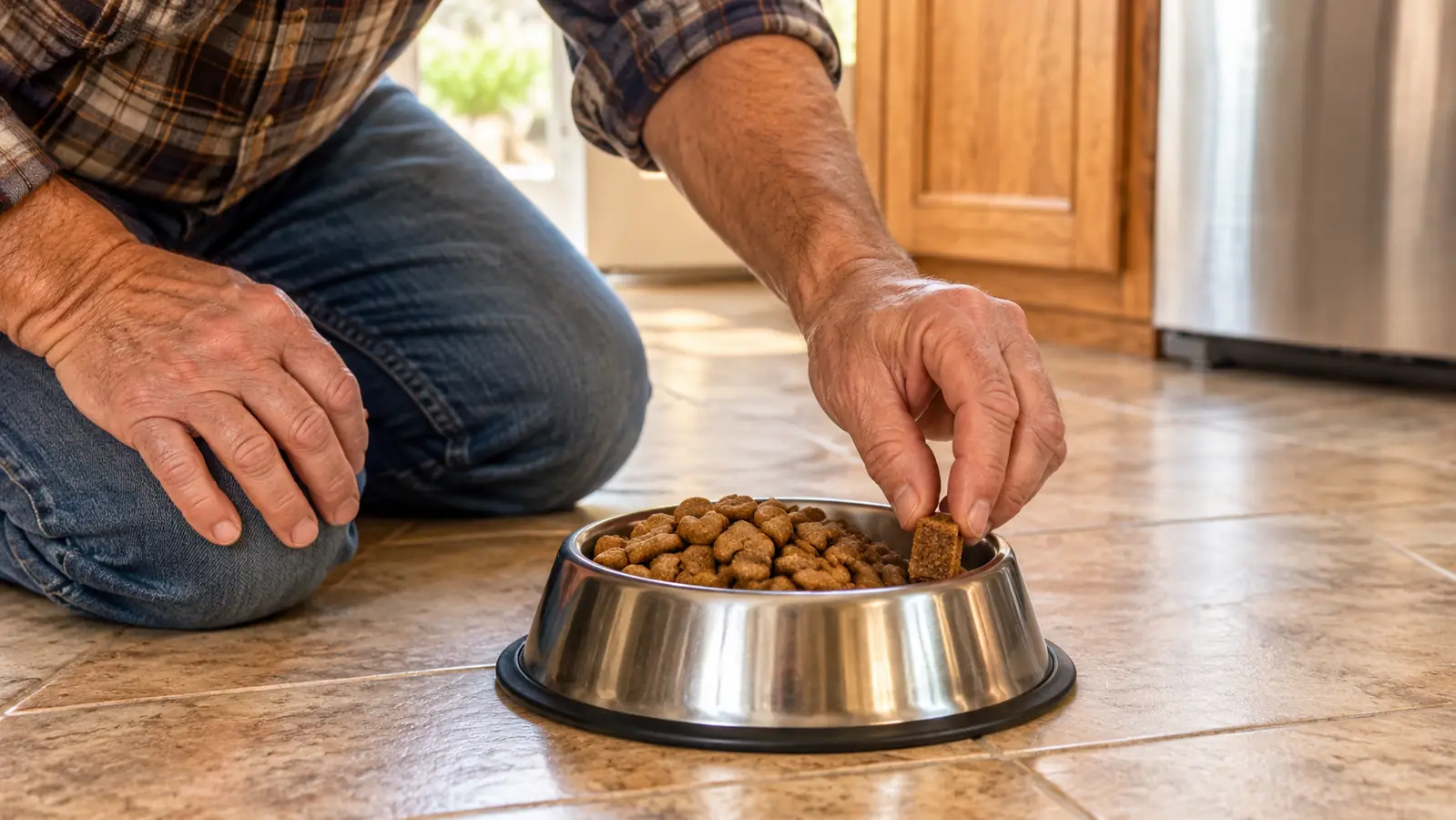
Honey gets her chews with breakfast, somewhere around seven, after she comes in from the yard. The bag sat on one shelf of the kitchen cabinet next to the refrigerator. I want to be honest about the training that happened there: she learned the sound of that cabinet door in about four days, and now she sits by the refrigerator at seven in the morning like she is on staff.
The fixed hour is not for the dog. It is for me. A supplement you remember four days out of seven is not a routine, it is a hobby, and you cannot measure a hobby. Same hour, same bowl, same shelf. If fish oil lives in your house too, it goes in the refrigerator door where you will see it twice a day, not in a drawer where it will quietly go off.
If you miss a morning, do not double up the next one. Give the normal amount at the normal time. Two missed days in a row is worth paying attention to, though, because it usually means the routine is set at an hour that does not fit your actual life. Move the hour before you abandon the habit. Seven works for us because I am up and the coffee is on. Pick the hour you are already reliable at.
Step 3: Dose to the Label for Her Weight and Then Leave It Alone
Honey is about seventy pounds. I did not eyeball the amount and I did not split the difference between two lines on the label. I read the amount for her weight, gave one soft chew with breakfast, and wrote that number on the notebook page so I would stop second-guessing myself at seven in the morning with a cup of coffee in my other hand.
The temptation with a soft chew is to add one because the first month did not look like much. Please do not. More is not better, the label is not a suggestion, and an ingredient list is not the kind of thing you improvise with. If you think your dog needs more, that is a phone call to your vet, not a second chew. I am not a vet and I will not pretend to be one. Neither should a bag on a shelf.
Storage is the boring part that matters. Soft chews go gummy if they sit somewhere steamy, so mine stayed on the cabinet shelf away from the stove and I kept the bag folded shut. If your kitchen runs humid in July, think about that before you buy 180 of anything.

Step 4: Track Four Small Things Instead of One Big Feeling
"Does she seem better?" is a useless question. I answered it differently every single day depending on my mood, and my mood is not data. So I stopped asking it. Instead I scored four things each evening from one to five: how she got up from a nap, how she handled the three porch steps, whether she hesitated at the car door, and how far she wanted to walk on the afternoon loop.
None of that is a medical measurement. Those four are simply the places where Honey's stiffness showed up first, and the porch steps were my favorite because there are exactly three of them every single day. A three-step staircase does not care what kind of morning you are having.
Here is what four months of VETIQ looked like in that notebook, and I will give it to you straight: a small change at best. She was not worse. She was also not clearly better, and by the end of May I had four months of numbers saying so. That is what a notebook buys you. It turns a vague worry into a question you can carry to a professional.
Early in June our vet examined her and said early arthritis in both hips, mild in the left elbow. That is a diagnosis. No supplement on a shelf can hand you one, and I would be lying if I said otherwise. It took a vet's hands to say those words, and the notebook is what got us into the room months earlier than a shrug would have.
Step 5: Carry the Notebook and the Bag to the Vet and Let Her Steer
I brought both. Our vet read the VETIQ ingredient list, asked how long we had been on it, and looked down my four columns. Then she made a change. Cosequin, plus a fish oil, and stop the VETIQ so we were not stacking glucosamine. I followed that exactly. Since mid-June Honey has had Cosequin with breakfast and an unflavored fish oil pumped over her dinner kibble, both at the amounts our vet set.
The first clear change came about six weeks in, late in July. Fewer stiff first steps after her naps and smoother on the porch steps. I want to be careful here, because cold mornings still find her taking those steps one at a time, and she still sometimes waits for a hand under her hips to get into the back seat of the car. Better is not the same word as cured, and anyone who tells you otherwise has something to sell.
Two more things went in later with our vet's blessing. In August, a soft chew treat after the afternoon walk replaced the plain biscuit Honey was already getting. In September, a turmeric chewable with dinner on a trial run, and I will tell you plainly that two months in I cannot point to a change I would credit to it. The routine grew without getting complicated, because each addition went in one at a time and got written down.
Four months on VETIQ and my honest note read: a small change at best. That sentence is why Honey was diagnosed in June instead of December.
What Else Helps
A supplement is one leg of a stool. Honey's weight is the first of the others, and it costs nothing. Every extra pound on a seventy-pound Labrador with arthritis in both hips is a pound she carries up those three steps. Our vet watches it and so do I, which means fewer bites from my plate than Honey believes she is owed.
The floors in this house are hardwood in the living room and hall and tile in the kitchen. I put two cheap runners down where Honey turns, and I moved her couch quilt to the corner where the afternoon sun lands. A thick bed beats a thin one on a cold floor, and none of that is expensive.
Walks stayed short and stayed daily. Two loops of about twenty minutes, morning and late afternoon, the same streets at the same pace. Shorter and more often beat one long outing for a stiff dog. On cold mornings I boost her into the car with a hand under her hips, and then I use the porch rail to get myself down the steps. Neither of us is nineteen.
And none of this replaces your vet. I am a retired librarian with a notebook and a soft spot for a yellow dog. Our vet is the one who looked at Honey and said the word arthritis out loud. If your dog is stiff and has not been examined, put the bag down and make the appointment first. The chew can wait a week. A diagnosis should not.
One Chew, One Hour, One Page a Day
That is the whole routine, and it is a reasonable place to begin if your dog is still happy to take a soft chew with breakfast. Honey's four months on VETIQ gave me the notebook page that sent us to the vet, and I do not regret a single chew.
Amazon Check Today's Price on Amazon →