
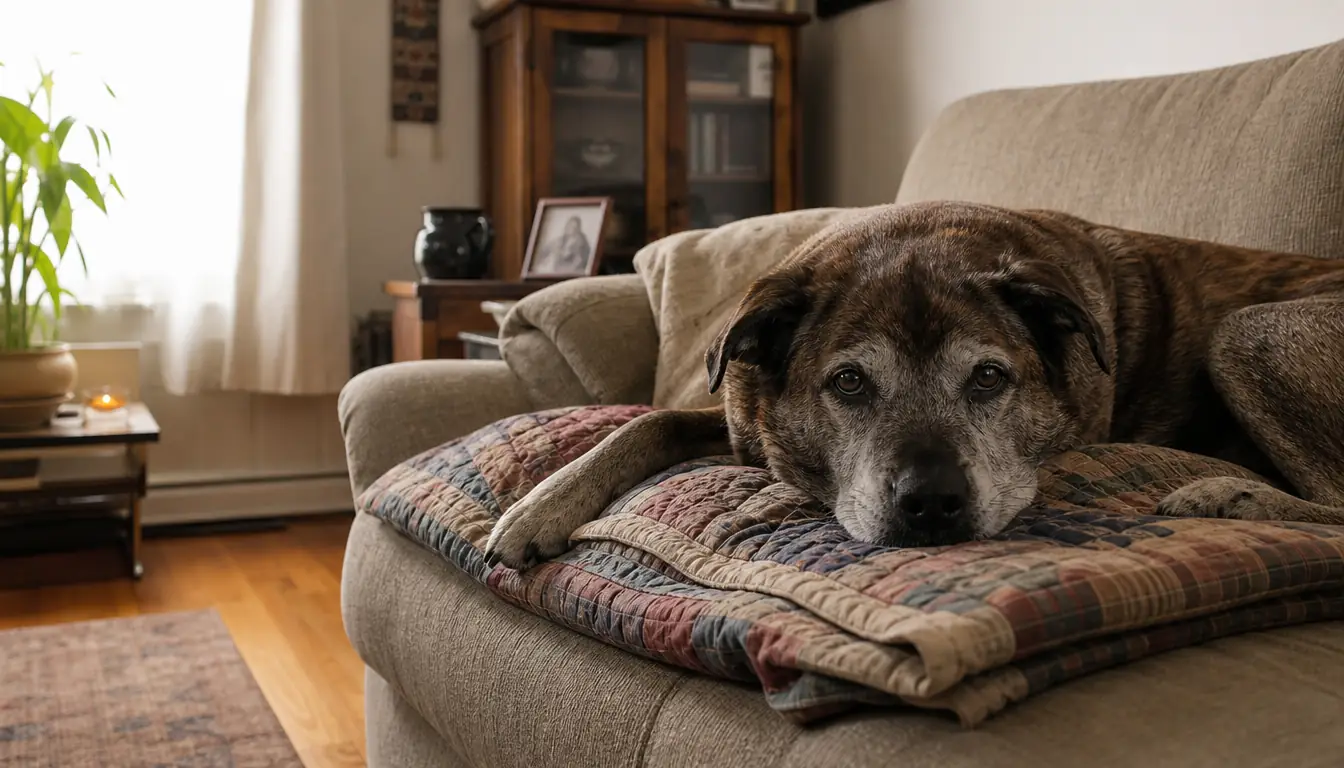
Last January I stood at the back door and watched Honey take the three porch steps one at a time. Front paws down, a pause, then the back end. She is a yellow Labrador retriever mix, ten years old, about seventy pounds, and she had been taking those steps in one loping motion since I brought her home from the county shelter eight years ago. No fall, no yelp, no limp. Just stiff for the first few minutes after a nap.
I did what I always do. I read, then I bought the easy thing. In early February I started her on a soft chew from the grocery aisle because it cost almost nothing, and by June I could not honestly tell you it had done a thing. That is what got me into our vet's office: not a crisis, just the suspicion that I was buying hope in a jar and calling it a plan. Our vet put her hands on both hips, took X-rays, and said the word out loud. Early arthritis in both hips, mild in the left elbow. She recommended Cosequin, from Nutramax Laboratories, plus a fish oil, and told me to stop the other chew so Honey was not getting glucosamine from two directions at once.
The One Our Vet Named First in June
Nutramax Laboratories Cosequin chewable tablets, 132 count, with glucosamine hydrochloride, sodium chondroitin sulfate and MSM. Five months in, it is the base of Honey's morning routine.
Amazon Check Today's Price on Amazon →Five Steps, In the Order I Actually Took Them
I am not a veterinarian. I am a retired school librarian who kept a notebook and asked a lot of questions. The five steps below are what our vet walked me through and what I would do again in the same order. If your dog is stiff, the first step is the one that really matters and the other four are the follow-through.
Step 1: Get the Diagnosis Before You Buy the Bottle
It is tempting to skip ahead. A stiff dog, a shelf of supplements, a credit card. I did exactly that in February and it cost me four months and a false sense of progress. When Honey was still slow in June, our vet put her hands on both hips and both elbows, watched her walk away and back, and took X-rays. She could tell me which joint was bothering her and how much. I could not have guessed that from the back porch, and it changed what she recommended.
There is also the matter of what else it could be. Our vet talked through the possibilities she wanted to rule out before we settled on arthritis, and she was clear that a supplement is not a treatment for a torn ligament or a spinal problem. If your dog suddenly cannot bear weight, or cries when picked up, or stops eating, that is a same-day call, not a supplement question. Stiffness that creeps in slowly over months is the case where a joint supplement makes sense.
The visit also gave me a baseline. Our vet wrote down how Honey moved that day, which hip caught, how long she took to rise. I did not know it yet, but I would be comparing everything to that note for the next five months.
Step 2: Read the Label and Dose for the Actual Weight
Cosequin chewable tablets are not a one-size thing. The label gives an amount based on the dog's weight, and the bottle I buy is the 132 count from Nutramax Laboratories because on the starting amount Honey went through them faster than I expected. Our vet set the starting amount for her seventy pounds and agreed with what the label said, and I wrote both numbers in the notebook so I would stop second-guessing myself every morning.
One thing I got wrong with the first product was doubling up. Two products can both contain glucosamine, and it is easy to give more than you intended without noticing. When our vet started Honey on Cosequin in June, she had me stop the grocery-aisle chew entirely rather than run both. If you are already giving something, bring the bottle to the appointment. Our vet read the ingredient panel of mine in about ten seconds and told me what to drop.
And the plainest advice I can offer: follow the label for your dog's weight, and let your vet set the starting amount. I am not going to give you numbers here. Your dog is not my dog, and the label and your vet are the two sources that actually know.
Step 3: Pick One Time of Day and Never Move It
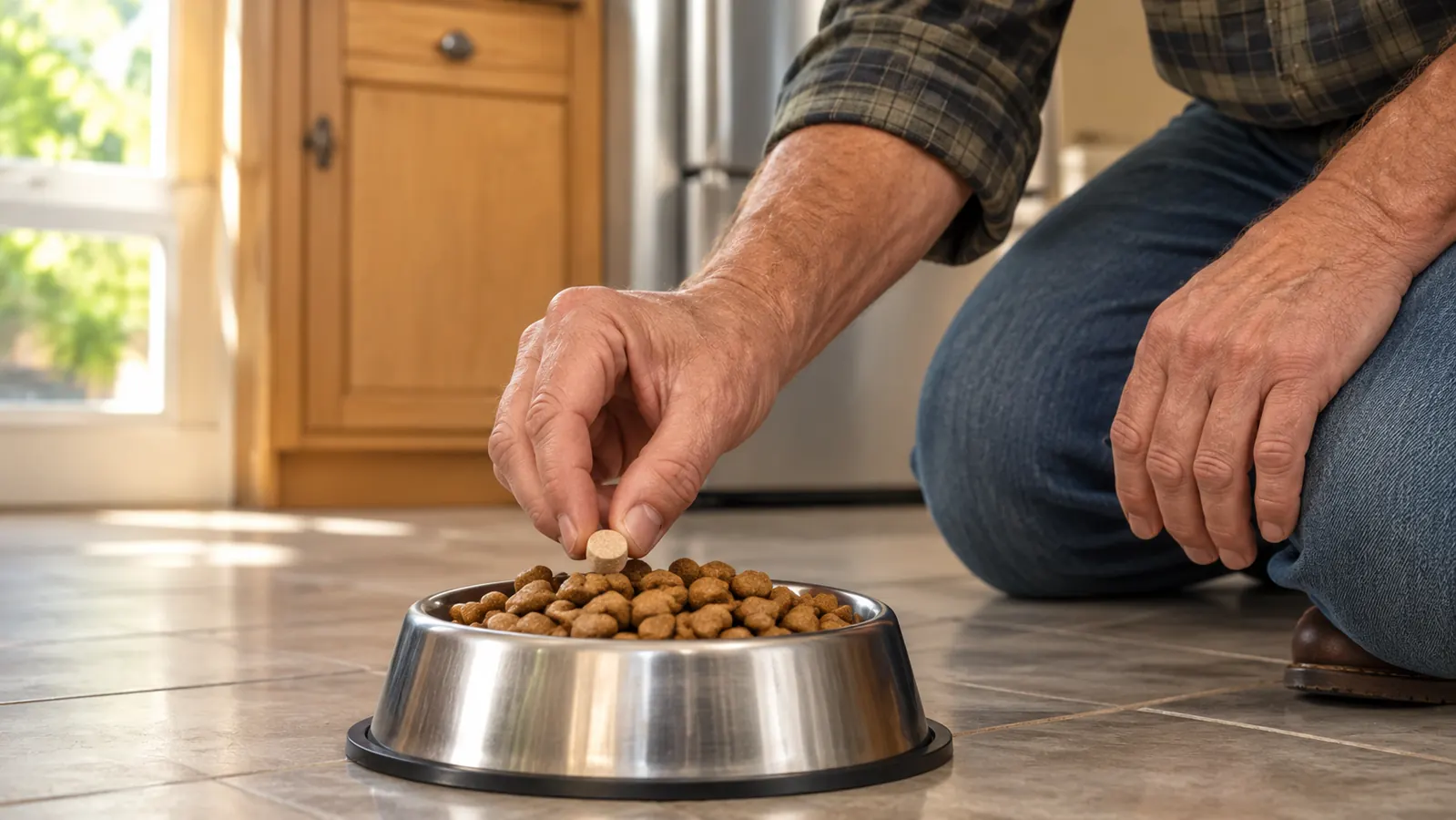
Cosequin goes in Honey's breakfast bowl. Not dinner, not a treat, not whenever I remember. Breakfast, every morning, in the same stainless bowl on the same tile. That sounds like a small thing and it is the difference between a routine and a good intention. She takes it without fuss, which helps, but the reason it works is that it is attached to something that already happens every single day.
I keep the tablets on one shelf of the kitchen cabinet next to the refrigerator, and the fish oil in the refrigerator door. Out of the sun, out of the damp, where my hand goes without thinking. When I drive to my sister's for a weekend, the tablets go in a sandwich bag in my purse and the schedule does not change. Five months in, I have not missed a morning that I know of, and I know of it because the notebook says so.
If your dog is a gulper who inhales breakfast, watch the first few mornings to be sure the tablet actually went down and was not left in the bowl. Honey is a careful eater and leaves nothing behind. A friend from church has a terrier who can pick a tablet out of kibble and set it on the floor like a complaint.
The first honest change came around six weeks in, and it was smaller than I wanted: fewer stiff first steps after a nap. On cold mornings she still takes the porch steps one at a time. Better is not the same as cured.

Step 4: Write Down the Small Things, Not the Big Ones
I expected a moment. Some morning when Honey would trot down the porch steps and I would simply know. That is not how it went, and I suspect it is not how it goes for most dogs. What changed was small and easy to miss if I had not been writing it down: whether she hesitated at the top of the steps, how long she took to rise after a nap, whether she jumped into the back seat of the car on her own or waited for me.
The notebook is a cheap spiral thing. One line a day: date, weather, and a number from one to five for how she moved that morning. Cold mornings get their own note because cold mornings are worse and always have been. The weather matters more than I expected. A warm week can look like progress and a cold snap can look like failure when neither one is telling you anything about the supplement.
The other reason to write it down is that memory is generous. By August I was sure she was better. The notebook showed me she was better in specific ways and unchanged in others, and that honest picture is what I took back to our vet in September.
Step 5: Give It Six Weeks Before You Decide Anything
The first clear change came around six weeks in, in late July. Fewer stiff first steps after a nap. Smoother on the porch steps. Not a transformation and not a cure, and I want to be careful here because it is the part people most want overstated. On cold mornings she still takes those steps one at a time, and she still sometimes waits for a hand under her hips to get into the back seat of the car.
Six weeks felt like a long time in July. But a joint supplement is not a pain pill. It is not going to work in an afternoon, and if you judge it after four days you will quit something that might have helped. Our vet told me to give it time, keep the rest of the routine steady, and come back if nothing had changed. That last part matters. Time is not a substitute for a follow-up.
What I would not do is stack five new things in the same week and then try to figure out which one worked. Honey started Cosequin and the fish oil together in mid-June, on our vet's advice, and I have been careful ever since to say I cannot separate the two. Everything after that came one at a time, weeks apart, so I could actually tell what I was looking at.
What Else Helps
Cosequin is the base of Honey's routine, not the whole of it. Our vet added a fish oil the same week, an unflavored liquid I pump over Honey's dinner kibble and keep in the refrigerator door after opening. I notice a softer coat. I cannot tell you what it is doing for her joints, and I would be making it up if I claimed I could separate it from the Cosequin.
The other two things came later and I hold them more loosely. In early August our vet said a mussel-based soft chew was fine to add, so it replaced the ordinary biscuit Honey got after her afternoon walk. I like that a treat I was handing out anyway now does something. In early September I started a turmeric chewable with our vet's okay. That one is the newest and least proven part of the routine, I have seen nothing I can pin on it, and I will finish the bottle before I decide.
The unglamorous things helped as much as any bottle. Honey has a folded quilt on her spot on the couch, and I put a cheap runner over the hardwood in the hall so she is not sliding when she turns around. Two short walks a day instead of one long one. A hand under her hips for the car, every time, without making a production of it. Our vet has also mentioned keeping her weight steady, which for a Labrador is a lifelong project and not a supplement question.
If you are where I was in February, standing at the back door watching your dog take the steps one at a time, the honest answer is that a supplement is one part of a plan and the vet is the other part. I wish I had made that phone call four months earlier. It would have saved me a jar of hope and given Honey a better summer.
Start With the One Our Vet Named First
Nutramax Laboratories Cosequin chewable tablets, 132 count. Read the label for your dog's weight, bring the bottle to your next appointment, and give it six weeks before you judge it.
Amazon Check Today's Price on Amazon →