

The part nobody puts in a review is the part where you cannot tell. I started VETIQ Glucosamine Hip and Joint Chews for Honey in early February, one soft chew with her breakfast, measured by the label for her weight. Honey is a ten-year-old yellow Labrador mix, about seventy pounds, and she had been getting up stiff from her naps since January. For four months I put that chew in her bowl and watched her the way you watch a pot of water. Some mornings she came off the couch easy and went straight to the door. Other mornings she took the three back porch steps one at a time, the way she had in January, and I stood there in my robe trying to decide whether that counted as worse or the same. That is the honest starting point for this whole review.
I am not a vet, and I am not going to write this as though I am. I was a school librarian for thirty-two years, which means I read the label, I keep a notebook, and I check before I believe. What follows is one dog in one house in Franklin, Tennessee: what four months of VETIQ looked like, what the container actually lists, where it helped, and the morning in June when I decided it was not enough on its own. If you want a promise, the listing has thirty thousand reviews and plenty of them will give you one. If you want the plain version, including the part where I stopped, keep reading.
The Quick Verdict
A soft chicken chew Honey never once refused, and a label that lists real amounts instead of a vague blend. It gave us four steady months and no clear turning point. A fair first step, not a fix.
Amazon Check Today's Price →If Your Dog Is New to Joint Support, This Is a Reasonable Place to Begin
Soft chews, chicken flavor, 180 in the container, with glucosamine, fish oil and krill on the label. It is the one I started with, and knowing what I know now I would start there again, with a vet appointment on the calendar at the same time.
Amazon Check Today's Price on Amazon →How I've Used It
I want to be honest about the order of events, because it is the part I would change. I bought VETIQ before I had a diagnosis, not after. Honey had never taken a joint supplement of any kind before this container. She was nine when the stiffness started and ten by the time I did anything about it, slow off the couch after her naps, careful on the three wooden steps down to the fenced yard, and hesitating at the back door of the car before she jumped into the back seat. I did what a lot of people do. I picked something with a plain label and started, and I told myself I would see how it went.
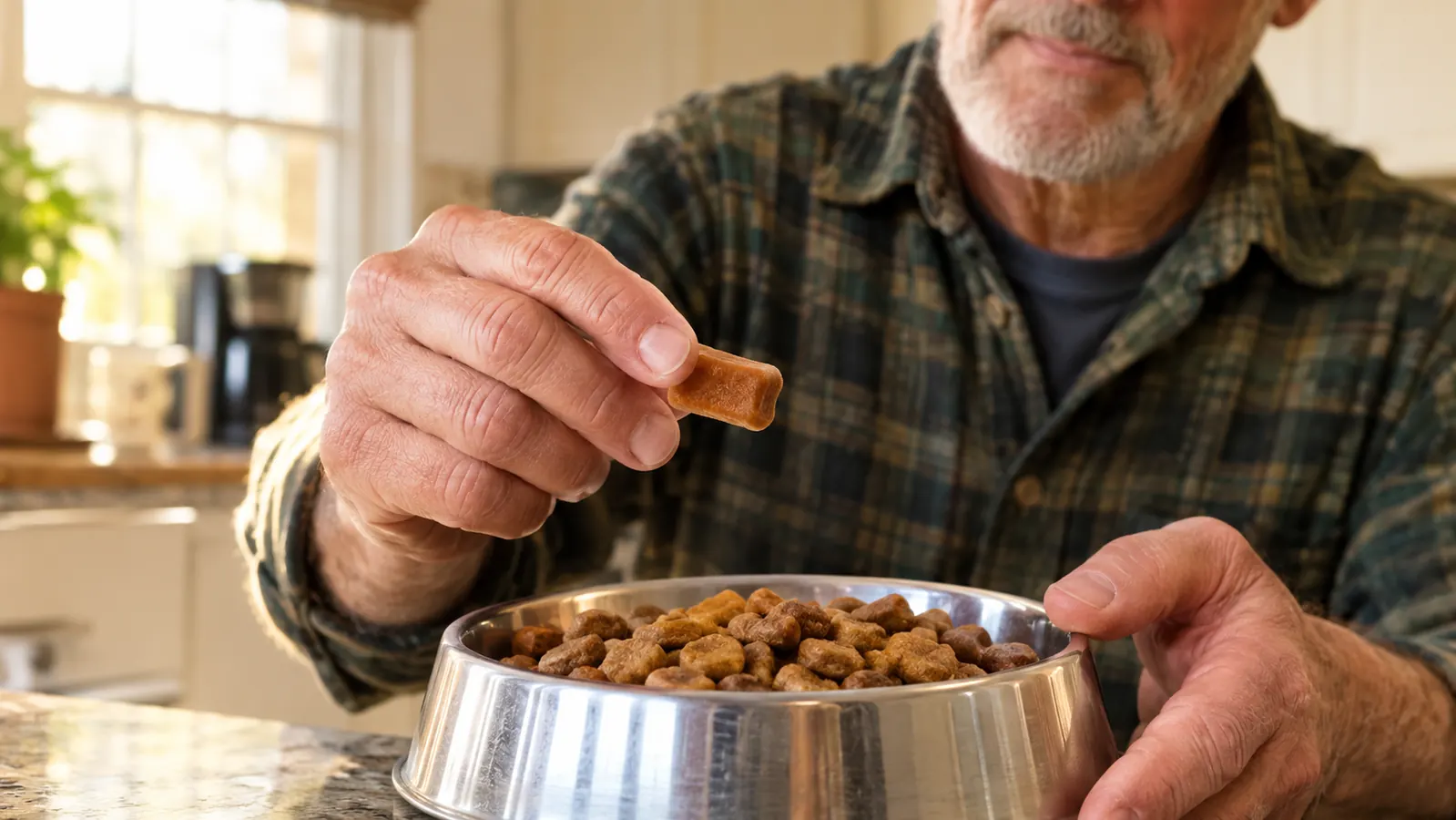
The routine was simple. One soft chew with her breakfast, per the label for her weight, which our vet later agreed was a sensible amount. She ate it dry out of my hand the first morning and out of her bowl every morning after. Honey is not a dog who will take a pill wrapped in cheese and pretend she has not noticed. She notices a pill. She never once noticed these. The container lived on the shelf in the kitchen cabinet next to the refrigerator, and it was the easiest part of my morning. I set it beside the coffee can so I would see it before I saw anything else, and the chew went into her bowl while the coffee was still brewing. Four months of that, from the first week of February to the first week of June, is somewhere around a hundred and twenty chews. I know the number because I counted what was left in the container when I closed it for the last time, which is the sort of thing a retired librarian does on a Wednesday morning with nothing else on the calendar.
Honey has a spot on the couch with a folded quilt on it, and she is on that quilt most of the afternoon. That is how I noticed in the first place. A dog getting up off a couch tells you more than a dog on a walk, because on a walk she has somewhere to be and she will push through it. Off the couch, with nobody watching but me, she took her time. If you are trying to decide whether your own dog is stiff, watch the getting up and not the walking.
I kept a notebook, because that is what I do. Nothing fancy, just a line or two after the morning walk: how she came off the couch, how she did on the steps, whether she hesitated at the car. I dated every line, which matters more than it sounds, because by April I had a page of mornings and no memory of which Tuesday was which. You cannot see a trend in one morning. You can see one in a month of mornings, and that notebook is the only reason I can tell you anything truthful four months later instead of just telling you how I felt about it.
What the Label Actually Says
Here is what made me comfortable opening the container in the first place. VETIQ lists amounts, not a proprietary blend with a cheerful name. Glucosamine HCL at 600 mg, fish oil at 280 mg, krill at 210 mg, and the product name on the label carries MSM as well. That is a label you can read out loud to your vet, and in June I did exactly that, with the container in my bag on the examining room floor.
She listened without laughing, which I appreciated, and then she asked me for the amounts. I read them off the side of the container and she wrote the glucosamine number down in her own handwriting. That is the only reason I can tell you what was in the container four months later. Not because I remembered it, but because it is in her handwriting in the back of my notebook, dated the fourth of June, and I have looked at it more than once since.
The rest of the listing is plain too. Soft chew, chicken flavor, 180 chews in the container, which measures about 3 by 7 by 9 inches and a little over a pound, so it stacks on a kitchen shelf without taking over the cabinet. The listing also mentions digestive and skin and coat support. I will tell you plainly that I saw no change in Honey's coat from these. I was not watching for one, and the fish oil she started in June is a different bottle entirely.
One thing on the label I want to put in front of you, because nobody mentions it. The glucosamine is listed as shellfish sourced. If your dog has ever had a reaction to shellfish, or if you simply do not know, that is a question for your vet before the first chew and not after. I asked. It cost me one phone call and it was worth making.
The Four Months, Honestly
February into March I could point to nothing. Honey still got up slow. She still took the steps one at a time. I told myself the chews needed time to build up, which is what everyone says, and which is also true of most things worth doing. It is not a lie. It is just not evidence either, and I want to be clear about the difference.
April and May gave me a small change at best. Some mornings she came off the couch and went straight to the door without the pause. Then a cold damp week would come through and we were back to the steps one at a time, her back end dipping a little on the second one. That is the honest shape of it: better on some days, the same on others, no straight line. If you read a review that says week three changed everything, remember that week three is also when the weather turned warm.
There was a Tuesday in late April that I still think about. The temperature had sat in the sixties for a week, Honey had come off the couch without a pause five mornings running, and I wrote seems better in the notebook with more confidence than the evidence deserved. Two days later a front came through, it dropped into the forties overnight, and she stood at the top of the porch steps for a good ten seconds before she took the first one down. Nothing about the chews had changed between those two mornings. The weather had. I crossed out seems better and wrote weather in the margin, and that margin note turned out to be the most useful thing on the page.
What finally moved me was not the chews failing. It was the arithmetic. Four months had gone by, I had a notebook full of maybes, and I still could not tell you whether Honey was better because of VETIQ or because the ground had thawed. Our vet looked at her in early June and said early arthritis in both hips, mild in the left elbow. I am glad I went. I wish I had gone in February with the container in my bag and asked first, and saved myself four months of squinting at my own dog.
Why I Stopped, and What We Do Now
Our vet started Honey on Cosequin in June, plus a fish oil. I asked whether to keep the VETIQ going alongside it and the answer was no, not both, because I would be doubling up on glucosamine without any real idea of what the second product was adding. So I closed the container, moved it to the top shelf, and stopped. I did not finish it and I did not throw it out either.
I want to be careful here, because stopping is not the same thing as a bad product. VETIQ did not fail Honey. It carried us from February to June, it never once turned breakfast into an argument, and it got me to a vet visit I had been putting off since January. It was a first step. The trouble was that I had quietly decided the first step was the plan.
What she does now, for the record, is Cosequin with breakfast, a pump of fish oil over her dinner, one soft chew treat after the afternoon walk, and a turmeric tablet with dinner, which our vet okayed as a trial and which I am still making up my mind about. She is better, not cured. On cold mornings she still waits for my hand under her hips to get into the back seat of the car. That is where we are in November, and the joint chews I started with are not part of it.
What I Liked
- Soft chew in a chicken flavor Honey took from my hand with nothing hidden in it
- The label lists milligrams instead of hiding behind a named blend
- 180 chews in the container, so one a day lasts a long while
- Glucosamine together with fish oil and krill, plus MSM named on the product
- A sensible first step while you line up a vet appointment
Where It Falls Short
- I saw a small change at best across four months
- It cannot tell you what is actually wrong with your dog
- The glucosamine is shellfish sourced, which needs a vet conversation first if allergies are a question
- If your vet wants a different plan you may end up with a half full container on the shelf
- It did not replace the fish oil our vet added in June
Four months, one chew with breakfast, and the truest sentence I can write is that Honey took the porch steps easier some mornings and not others. That is not nothing. It is also not a diagnosis.

The Small Things Nobody Mentions
Chicken flavored soft chews smell like chicken flavored soft chews. If you keep the container in a small kitchen, you will know it is there. That is not a complaint, just a fact of the format, and it is worth knowing before you order a hundred and eighty of them.
They are soft, which is the whole point for an older dog with sore teeth, and soft is also what makes them easy to overdo. A determined dog could empty a container in one sitting. Honey is not a counter surfer, but the container went on a high shelf anyway, and I would tell you to do the same. I also counted them out one at a time into her bowl rather than eyeballing a handful, because a handful of soft chews is a larger handful than it looks.
One more thing about judging a chew, and this is the librarian in me. Between February and June the weather changed twice, arthritis has good weeks and bad weeks all on its own, and Honey turned ten somewhere in there. Any of those can explain one good morning on the porch steps. That is why I say small change at best instead of telling you it worked. I could not separate the chew from the season, and you will not be able to either from your own kitchen. All you can do is write it down and take the notebook to the vet.
And the count. A hundred and eighty chews sounds like a generous supply until your vet changes the plan in June and you are looking at a half full container on the top shelf. I am not sorry I bought it. I am telling you that the supply outlasts the decision, so buy it the way you would buy anything for a dog you have not had diagnosed yet: as a trial, with an appointment already on the calendar.
Who This Is For
This is for the person whose dog is a little slow getting up and who has not been to the vet yet, or who has an appointment coming and wants something reasonable to start with in the meantime, with the vet's okay. It suits a dog who will take a soft chew straight from your hand, a household that wants a label with numbers on it rather than a blend, and an owner who understands that four months of a chew is a trial and not a treatment plan. Bring the container to the appointment. Read the amounts to your vet. Let her tell you what she thinks, because she can put her hands on your dog and I cannot put mine on yours.
Who Should Skip It
Skip it if your dog has a shellfish allergy or you do not know whether she does. Skip it if she is already on another glucosamine product, because stacking two of them is a decision for your vet and not for a Tuesday morning. Skip it if she is lame, yelping when you lift her, or dragging a back leg, because that is not a chew question, that is a phone call today. And skip it if what you want is a guarantee. There is no guarantee in this container, or in any other. Honey is better than she was in January and she is not the dog she was at seven, and nothing on a shelf is going to change the second half of that sentence.
Read the Label Out Loud, Then Make the Vet Call
If you are going to start somewhere, start with something you can read out loud and a vet who knows your dog. VETIQ is a fair first chew for that in-between stretch, and I would buy it again for a dog just beginning to slow down.
Amazon Check Today's Price on Amazon →